Siamese Cassia
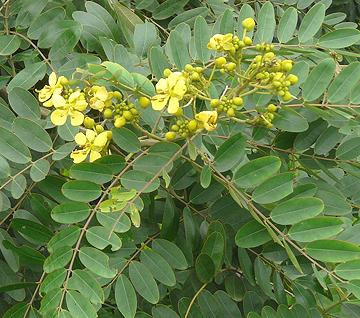 [Kassod Tree, Cassod Tree, Cassia Tree; Senna siamea (Formerly
Cassia siamea)]
This tree is used in the cuisines of Thailand and Burma, and pretty much
nowhere else. Both leaves and flower buds are used in soups, curries and the
like. Leaves and buds are available lightly pickled in jars here in
Los Angeles. Young pods and seeds are also said to be edible, but must be
boiled and the water discarded 3 times to remove toxins. Various parts of
this tree are also used medicinally.
Photo by Dinesh Valke distributed under license
Creative Commons
Attribution-Share Alike 2.0 Generic.
More on Cassias & Sennas.
 These fresh leaves are from my
Senna leptophylla tree, the stem
of young leaves was 8-1/2 inches long. The pickled ones are
Senna siamea, and were purchased from a large Asian market in Los
Angeles. They were from Thailand, labeled "Preserved Cassia Leaves". Ingred:
water, cassia, distilled vinegar, salt, sodium benzoate.
I wasn't real impressed with the edibility of the Thai leaves but
perhaps fresh ones are better. It is reported that they are brought to a
boil and the water discarded 3 times. Most, but not all, bean toxins are
destroyed by cooking.
 In the photo to the left are cassia bud clusters that had been packed in a
light brine. These were from Thailand, but purchased from an Indian market
in Los Angeles. The largest were 3/8 inch diameter. They had a subtle
flavor with a touch of bitterness. I do not know if they require the same
boiling to remove toxins as the leaves. I lightly simmered a few buds from
my Senna leptophylla and experienced no ill effects, but I didn't
eat a whole lot of them. They had a light bean-pea flavor, and the same
touch of bitterness in the aftertaste as the Thai ones.
bp_sennasz 260823 - www.clovegarden.com
©Andrew Grygus - agryg@clovegarden.com - Photos on this
page not otherwise credited are © cg1 -
Linking to and non-commercial use of this page permitted