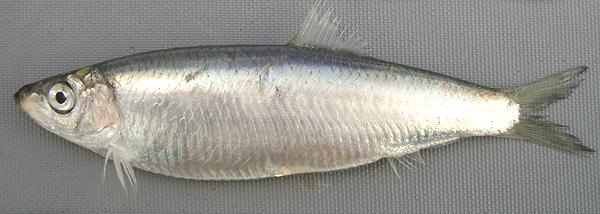
 [family Clupeidae (herring family); Genus Sprattus]
Sprats are small schooling fish similar to, and closely related to, Sardines, but a bit smaller and different enough to have their own genus and be called "Sprats". By far the most economically important sprat is the European (see below) but it is not the only one. There is also a a commercially fished sprat (Falkland Sprat; S. fuegensis) off the southern coast of Argentina and around the Falkland Islands. There is also a commercially fished Sprat off the coast of Tasmania, Australia (Australian Sprat; S. novaehollandiae). There are two all around the coasts of New Zealand (New Zealand Sprat; S. muelleri and New Zealand Blueback Sprat; S. antipodum) but these are not fished commercially, only in subsistence fisheries. Photo from Muséum National D'Histoire Naturelle distributed under license Creative Commons Attribution-NonCommercial-NoDerivatives 4.0 International.
More on Fish Products
More on Varieties of Fish
(very large page).
 [Brisling, Bristling, Skipper; Sprotos (Lithuania);
Sprattus sprattus]
[Brisling, Bristling, Skipper; Sprotos (Lithuania);
Sprattus sprattus]
This is the most economically important Sprat. They are found in great
quantity in the North Sea and Baltic Sea, and all around the
British Isles and the North and Northwest coasts of France. They are
less common along the west costs of Spain and Morocco, but are fairly
common in the Black Sea, though that fishery has seriously declined.
This fish can grow to 6-1/4 inches long, but is commonly about 4-3/4
inches. The photo specimen was 4-1/3 inches long. The Sprat fishery
is particularly important to Latvia, but also Estonia, Lithuania and
Poland.
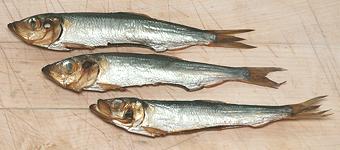 [Rukytos Sprotos (Lithuania); Sprattus sprattus]
These Sprats are smoked, but not beheaded and canned. Each has a hole at
the back of the head where a rod was stuck through to hang them for
smoking. They measured from 6-1/2 to 4-1/2 inches long and weighed an
average of 0.3 ounces each. They go very well with Beer. I just snap off the head
and eat them right down to the tail. These were from Lithuania,
purchased from Jon's market in Gelendale, CA, in a half pound tub at
2019 US $6.99 / pound. Ingred: herring, salt.
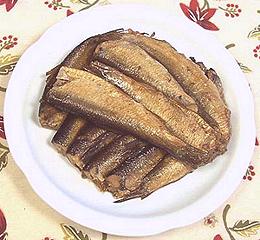 [konservetas sprotes (Latvia); konservuoti sprotai (Lithuania);
Sprattus sprattus]
[konservetas sprotes (Latvia); konservuoti sprotai (Lithuania);
Sprattus sprattus]
This is the form in which
most people know Sprats. They are smoked, beheaded (to fit in the can
better) and packed in 4 inch diameter by 1 inch high cans with sunflower
seed oil and salt. Some larger ones are put up in jars. These are enjoyed
by persons of taste, but are definitely too strong for the baby spinach
set. They go exceptionally well with ice cold vodka and strong Russian
tea. Fortunately plenty are now exported to North America, particularly
from Latvia, and I keep a good stock. They should be eaten within about
4 years, because some of the cans eventually start to leak.
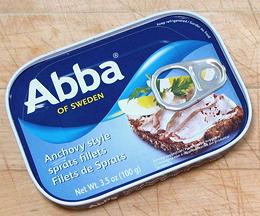 These are Sprats, canned in a special
spiced brine flavored with Cinnamon and Cloves, and called
Ansjovis in Sweden, Denmark and Finland. Countless attempts to
make the famous Swedish dish
Jansson's Temptation
(Janssons Frestelse) have been totally ruined by following
recipes that translated "Ansjovis" to "Anchovies" without further
discussion. These fish are also very common on the
Swedish Smögåsbord.
These are Sprats, canned in a special
spiced brine flavored with Cinnamon and Cloves, and called
Ansjovis in Sweden, Denmark and Finland. Countless attempts to
make the famous Swedish dish
Jansson's Temptation
(Janssons Frestelse) have been totally ruined by following
recipes that translated "Ansjovis" to "Anchovies" without further
discussion. These fish are also very common on the
Swedish Smögåsbord.
Ingred: Sprats fillets, sugar, salt, vinegar, sodium benzoate and
spices. I used to get these from the food section at IKEA, but they
don't have them now. They are currently available on-line for about
2018 US $5.49 plus $5.99 shipping (perishable item), but the cans are
pink, not blue, and hold 4.4 ounces rather than the blue can's 3.5
ounces. Fortunately, with the fall of the Soviet Empire, we don't
have to depend on Sweden any more (see next entry).
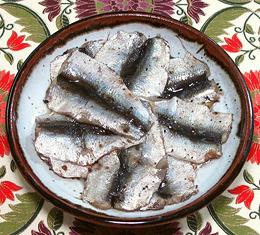 These Sprats are pickled in a
spiced brine very much like that of the Swedish "Anchovies" (see above),
and would be perfectly suitable for Jansson's Temptation except they are
packed in light oil rather than brine. Details for using these will be
found on our Jansson's
Temptation recipe page. The photo specimens, from Lithuania,
were purchased from a multi-ethnic market in Los Angeles (Altadena) for
2018 US $4.49 for 6 ounces, packed in a flat plastic serving tray ready
for appetizer use (Bandi brand). Ingred: Baltic Sprat Fillet
(Sprattus sorattys baltica), salt, sugar, spices, sorbic acid,
sodium benzoate, polysorbate80, rapeseed oil.
These Sprats are pickled in a
spiced brine very much like that of the Swedish "Anchovies" (see above),
and would be perfectly suitable for Jansson's Temptation except they are
packed in light oil rather than brine. Details for using these will be
found on our Jansson's
Temptation recipe page. The photo specimens, from Lithuania,
were purchased from a multi-ethnic market in Los Angeles (Altadena) for
2018 US $4.49 for 6 ounces, packed in a flat plastic serving tray ready
for appetizer use (Bandi brand). Ingred: Baltic Sprat Fillet
(Sprattus sorattys baltica), salt, sugar, spices, sorbic acid,
sodium benzoate, polysorbate80, rapeseed oil.
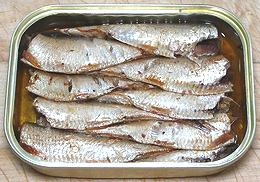 This form of European Sprats is so
named to differentiate these Sardine style Sprats from the heavily
smoked fish widely known as "Sprats". They are, or course, a different
genus from true "Sardines", but this confusion is for the sake of
clarity.
This form of European Sprats is so
named to differentiate these Sardine style Sprats from the heavily
smoked fish widely known as "Sprats". They are, or course, a different
genus from true "Sardines", but this confusion is for the sake of
clarity.
Sprats are very high in Omega 3 fatty acids, which are currently thought to be very beneficial for cardiovascular, mental and neural health. At least as high as Atlantic Salmon. They are also high in other minerals and vitamins.
Sprats, like other herrings, are high in purine content, so might be avoided by people with gout or high uric acid in their blood.
sf_spratz 11 r 160329 - www.clovegarden.com