Lichens are symbiotic composite organisms consisting of a fungus body within which live either single cell algae or cyanobacteria. This relationship, playing on the strengths of each, allows the organism to live in extremely harsh environments, from arctic tundra to dry deserts and on bare rock, though they are also abundant in temperate and rainforest environments. Lichens are used as food by many cultures around the world, sometimes as a survival essential and sometimes as a delicacy.
More on Fungus.
More on Algae & Cyanobacteria
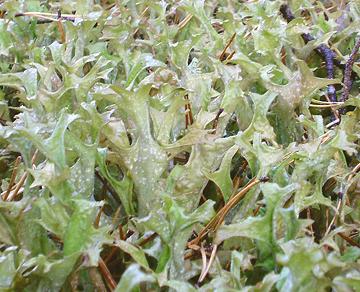 [Cetraria islandica of family Parmeliaceae]
Not actually a moss, and not confined to Iceland, though it is particularly lush there. It grows in Arctic and sub-Arctic environments all around the northern hemisphere, and much farther south in alpine regions. For a lichen, it has an unusually erect growth habit. It is eaten by various northern peoples, and it is also used medicinally. The photo specimen is from central Sweden. Photo by Amphis contributed to the Public Domain.
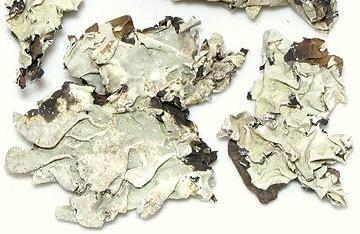
[Black Stone Flower; Dagad Phool (Marathi); Kalpasi, Kallupachi, Phathar
Ka Phool (Tamil); Riham karmani (Urdu); Kalahu (Kannada); Shaileyam (Sanskrit);
Dagar da Phool (Punjabi); Patthar ke phool (Hindi); Bojhwar, Chadila,
(northern India); Parmelia perlata of family Parmeliaceae]
This lichen is considered essential for making Goda Masala, a curry
powder used in the Marathi cuisine of Maharashtra, Goa and Karnataka. Its
earthy flavor is considered very important to the cuisine of that region,
but it is used to some extent in other regions, particularly Chettinad
(in Tamil Nadu) and Hyderabad (in Telangana). The photo specimen is from
India.
Details and Cooking
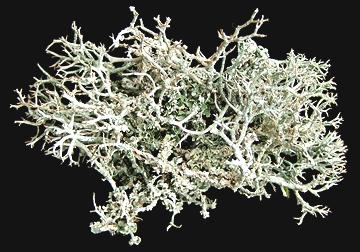 [Caribou moss, Reindeer lichen; Cladonia rangiferina - also -
Cladonia portentosa of family Cladoniaceae]
[Caribou moss, Reindeer lichen; Cladonia rangiferina - also -
Cladonia portentosa of family Cladoniaceae]
These slow growing lichens are found in Arctic, sub-Arctic and alpine regions all around the northern hemisphere, and are extremely cold tolerant. They are the major food for the Sami's reindeer herds.
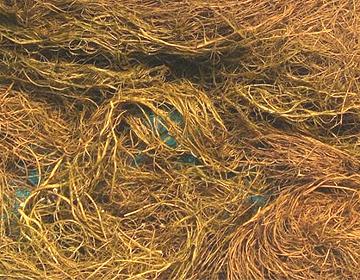 [Bryoria fremontii of family Parmeliaceae]
This lichen grows in hair-like clumps from tree branches, but is not parasitic. It inhabits the Mountain West of North America from the south of Alaska almost to Southern California. Some also grows in Russia and northern Europe. It was an important food for Native Americans and is still occasionally eaten as a traditional food.
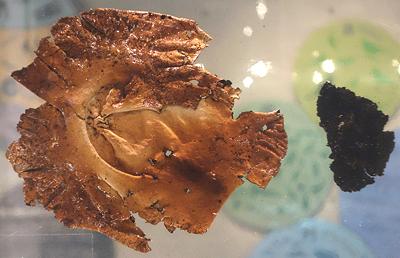 [Iwatake (Japan); Seogi (Korea); Umbilicaria esculenta of
family Umbilicariaceae]
[Iwatake (Japan); Seogi (Korea); Umbilicaria esculenta of
family Umbilicariaceae]
This lichen grows on rocks in East Asia, including Korea, China and Japan. It is is extremely slow growing, and all that was easily available has long ago been harvested. Harversters rappel down cliffs in wet weather (so it won't crumble) to gather it, with occasional fatalities. It is particularly favored in Japan, where an absurdly high price is the greatest known flavor enhancer. Photo by Daderot contributed to the Public Domain.