 [Brake Fern, Fernbrake; Gosari (Korea); Warabi (Japan);
Pteridium aquilinum]
[Brake Fern, Fernbrake; Gosari (Korea); Warabi (Japan);
Pteridium aquilinum]
A common fern in temperate climates, immature Bracken fronds are eaten as a vegetable in many parts of the world and particularly in Korea, Japan and parts of China. Native Americans dug up, cooked and ate the rhizomes from which the fronds sprout. These are still used in Japan, Sichuan, China and elsewhere, as a starch source (see noodles, below).
Bracken Fern is toxic to livestock when a significant part of their diet. For humans, fresh fern should be cooked (simmered 10 minutes) and eaten in moderation. One of the toxins is a thiamine inhibitor that can cause a vitamin deficiency if consumed for an extended period.
Bracken also contains a substance identified as a carcinogen (ptalquiloside), and has been placed in the same risk category as Coffee and Sassafras by the American Cancer Society. Study is ongoing, and there appears to be some cancer correlation for Korean and Japanese populations who eat fernbrake on practically a daily basis. Ptalquiloside is volatile and destroyed by heat. Currently there is insufficient data as to how much may remain in fresh boiled fernbrake, or dried, boiled, soaked and cooked fernbrake. Basically, cooked fernbrake seems safe enough for occasional use. Some varieties of fernbrake, particularly in New Zealand, do not contain this substance.
More on Culinary Ferns.
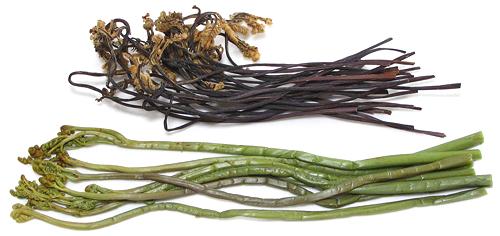
The photo specimens are water packed and dried examples from a local Korean market. The dried is most used in Korea, because young fernbreak fronds are seasonal.
Korean cooking maven Maangchi recommends this procedure:
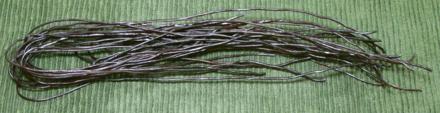 We found these noodles, made from starch extracted from bracken fern
root, in one of the large Asian markets here in Los Angeles. The strands
were 0.063 inch diameter and 20 inches long, folded in the middle. Cooked,
they resemble large, dark colored bean starch noodles, but have a lightly
earthy flavor, while bean starch noodles are pretty neutral. These come
from Sichuan China, ingredients: fern root starch, rapeseed oil.
We found these noodles, made from starch extracted from bracken fern
root, in one of the large Asian markets here in Los Angeles. The strands
were 0.063 inch diameter and 20 inches long, folded in the middle. Cooked,
they resemble large, dark colored bean starch noodles, but have a lightly
earthy flavor, while bean starch noodles are pretty neutral. These come
from Sichuan China, ingredients: fern root starch, rapeseed oil.