 [Indian Date; Tamarindo
(spanish); Asam (malay), Asem Jawa (Indonesia); Imli, Amli, Chinch
(India); Ma-kahm (Thai); Me (Viet); Puli (Tamil, Malay);
Tamarindus indica]
[Indian Date; Tamarindo
(spanish); Asam (malay), Asem Jawa (Indonesia); Imli, Amli, Chinch
(India); Ma-kahm (Thai); Me (Viet); Puli (Tamil, Malay);
Tamarindus indica]
Native to tropical Africa and Madagascar, the tamarind tree was known to the ancient Egyptians, and taken to India so long ago even botanists thought it was native there. From India it was introduced to Persia and the Arab world, thus Arabic "tamar hindi" (Indian date). It is now planted throughout the tropics and sub-tropics including Mexico, Central America, the Caribbean and southern Florida.
This hardwood tree can grow to around 70 feet but is in fact a legume,
related to the common green bean and pea. The sweet/sour fruit pulp
surrounding the seeds within the thin brittle shell are the part most used,
but leaf shoots and flowers are also used. Tamarind fruit pulp is an
important flavoring for food and beverages worldwide.and is an important
ingredient in Worcestershire sauce, HP Sauce (UK and Canada) and Jamaican
Pickapeppa sauce.
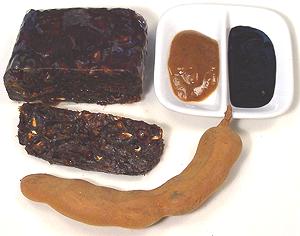
Tamarind pulp is widely sold in several forms, as illustrated in the photo above:
Measures Most Indian recipes call for pulp from blocks. Measures are usually by volume, sometimes tablespoons, but more often "the size of a golf ball", "the size of a lime" or "the size of a Gooseberry. Caution: limes in India (and most of the world) are what we call "Key Limes" here in North America. They are much smaller than our common Persian / Tahitian limes, and Indian Gooseberries are much larger than what we call a gooseberry in North America.
Is block better than concentrate? Yes, noticeably more tart and flavorful, nearly identical to fresh pods but easier to use because you don't have to pick off the shell and deal with the seeds. The result is much thinner than concentrate, but remarkably strong.
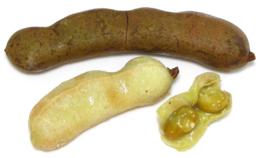
Immature pods are used in India to flavor rice. In the Bahamas green pods are roasted in ashes until they burst, then are dipped in the ashes and eaten. Immature pods are not much available in North America because the trees are unlikely to fruit here except at the southern tip of Florida. Mexico grows plenty, but does not ship immature ones north of the border.
The photo specimens were purchased frozen from a Philippine market
in Los Angeles, labeled Green Tamarind Fruit. These were fairly mature,
the shells already nearly brittle, but the flesh was green and seeds
quite soft. The flesh was quite tart, with a sweet-tart balance similar
to lemon. The seeds could be easily chewed, but you don't want to do
that. They were very bitter and astringent. The best way to peel these is
right out of the freezer compartment. Leave them in a bowl of hot water
for about 1 minute so the shell is softened but the flesh is still firmly
frozen. Thawed, the flesh can be eaten after pulling the fibers out
by the stem, or it can be squeezed for juice.
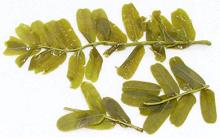 In India and Africa, tender leaf shoots are used as greens and in
soup. They can be purchased in jars packed in brine in some markets
serving Asian communities. These have a very light sweet-sour taste.
The hard stems must be removed, which is a hassle because they are in
little pieces, and the leaves don't strip off easily - not really
worthwhile in my opinion. If I lived in a growing region where I could
get them fresh, I might think differently. The stems in the photo carried
very thin leaves 0.3 inches wide and 0.7 inch long. Tamarind leaf, water,
salt, citric acid, sodium benzoate (preservative) sodium metabisulfate
(color preservative).
In India and Africa, tender leaf shoots are used as greens and in
soup. They can be purchased in jars packed in brine in some markets
serving Asian communities. These have a very light sweet-sour taste.
The hard stems must be removed, which is a hassle because they are in
little pieces, and the leaves don't strip off easily - not really
worthwhile in my opinion. If I lived in a growing region where I could
get them fresh, I might think differently. The stems in the photo carried
very thin leaves 0.3 inches wide and 0.7 inch long. Tamarind leaf, water,
salt, citric acid, sodium benzoate (preservative) sodium metabisulfate
(color preservative).
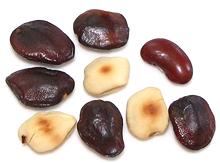
In the growing regions Tamarind seeds are roasted and eaten as a snack, as well as being ground to flour for use as a thickener. Despite being very nutritious with plenty of antioxidants and such, they currently have little use outside the growing regions. A process is being developed to use them to produce a substance similar to, but said to be superior to, fruit pectin for making jams and jellies.
As harvested from the dried pods sold here in North America, the
seeds are extremely hard and can withstand even a sharp hit with a
tack hammer. After roasting on a cast iron comal at 500°F/260°C
the outer shells are brittle enough to crack with a tack hammer and
pry off. The kernels are still very hard. In the growing regions,
children eat the roasted seeds like very hard candy, working on them
for a while. They can eat fresh seeds from ripening pods more easily
but those need to be roasted too as they are bitter and astringent
raw. Roasted, the flavor is similar but not identical to roasted
peanuts. I have seen them listed in an "alternate" recipe for Nigerian
Banga Soup Spice (a recipe calling for ingredients you can actually get).
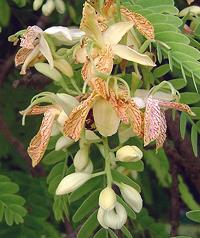 In India, flowers are used in salads and are made into a pickle in
southwest India.
Photo by Tau'olunga distributed under license
Creative Commons
Attribution-ShareAlike v3.0 Unported.
In India, flowers are used in salads and are made into a pickle in
southwest India.
Photo by Tau'olunga distributed under license
Creative Commons
Attribution-ShareAlike v3.0 Unported.
 In Indonesia, tamarind pulp is rubbed into pottery before firing to
produce a unique mottled reddish brown glaze.
In Indonesia, tamarind pulp is rubbed into pottery before firing to
produce a unique mottled reddish brown glaze.