Gold Medallion Tree
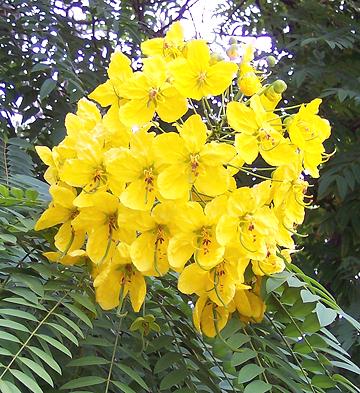 [Senna leptophylla (Formerly Cassia leptophylla)]
The photo is of my Gold Medallion tree. These are from southern Brazil and
but are extremely popular in Southern California, blooming intensively in
early Summer and setting large pods later. It is quite similar to the
Siamese Cassia (Senna siamea)
of Thailand, which is used in Thai and Burmese cuisine, and pretty much
nowhere else. Because of the similarity I have done a little experimenting
with it as described below.
More on Cassias & Sennas.
CAUTION: Years after my experiments I found that Siamese
Cassia leaves are toxic and should be boiled before use and the water
discarded, up to 3 times. Presumably that applies to this Senna as well.
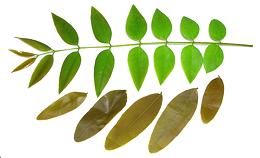 These fresh leaves are from my Senna leptophylla tree, the stem
of young leaves was 8-1/2 inches long. The pickled ones,
Senna siamea, were purchased from a large Asian market in Los
Angeles, and were from Thailand, labeled "Preserved Cassia Leaves".
Ingred: water, cassia, distilled vinegar, salt, sodium benzoate.
These fresh leaves are from my Senna leptophylla tree, the stem
of young leaves was 8-1/2 inches long. The pickled ones,
Senna siamea, were purchased from a large Asian market in Los
Angeles, and were from Thailand, labeled "Preserved Cassia Leaves".
Ingred: water, cassia, distilled vinegar, salt, sodium benzoate.
Senna siamea leaflets are more rounded at the tip, and the
leaf frond ends with a single terminal leaflet. Senna leptophylla
leaflets are more pointy and the frond ends in a pair.
After a fair amount of simmering the Senna leptophylla leaves
were still a bit fibrous with little flavor and not real pleasant to eat.
Of course, I wasn't real impressed with the edibility of the Thai leaves
either. Surprisingly, the green leaves taken from a single frond, colored
2 cups of simmering water the color of strong tea, and imparted a rather
pleasant tea-like flavor See caution above. It would work rather
well in soup stock, but I can't provide any real information about possible
toxicity, though sampling an ounce or so produced no ill effects, and
most, but not all, bean toxins are destroyed by cooking.
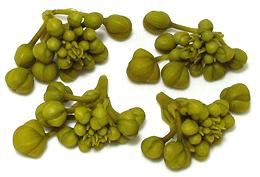 In the photo to the left are cassia bud clusters that had been packed in a
light brine. These were from Thailand, but purchased from an Indian market
in Los Angeles. The largest were 3/8 inch diameter. They had a subtle
flavor with a touch of bitterness. I lightly simmered a few from my
Senna leptophylla. They definitely were more edible than the
leaves, with a light bean-pea flavor, and the same touch of bitterness
in the aftertaste as the Thai ones (See Caution above).
In the photo to the left are cassia bud clusters that had been packed in a
light brine. These were from Thailand, but purchased from an Indian market
in Los Angeles. The largest were 3/8 inch diameter. They had a subtle
flavor with a touch of bitterness. I lightly simmered a few from my
Senna leptophylla. They definitely were more edible than the
leaves, with a light bean-pea flavor, and the same touch of bitterness
in the aftertaste as the Thai ones (See Caution above).
bp_cassz 120626 r 140719 - www.clovegarden.com
©Andrew Grygus - agryg@clovegarden.com - Photos on this
page not otherwise credited are © cg1 -
Linking to and non-commercial use of this page permitted