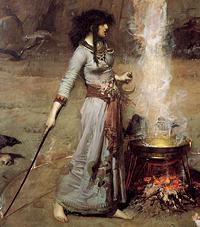
Witches
In Europe, witchcraft was considered a rather modest infraction, until the
late 1400s. Then it was conflated with heresy, and the notorious Witch Trials
began. "Thou shalt not suffer a Witch to live" (King James Bible, 1611).
"Witch" here, is a mistranslation of the Hebrew word for "poisoner", to
please King James, a notorious Witch hater.
Well into the 1700s, what Witches were and did was defined by hysterical
fantasy. Innocents, often widows, were tortured until they confessed they
were evil witches, belonged to "covens", and flew to "sabbaths" to dance
with the Devil. The most popular reference manual, Malleus Maleficarum
(1486), was denounced by the Inquisition as unrealistic, extreme, and in
violation of Catholic law, but to Protestants and the secular courts, it
was the law.
The rise of Science declared witchcraft delusional. By the beginning
of the 20th century, Witches were taken much less seriously. In Ambrose
Beirce's dictionary: "WITCH, n. (1) Any ugly and repulsive old woman in a
wicked league with the Devil. (2) A beautiful and attractive young woman, in
wickedness a league beyond the Devil."
So why are we talking about Witches now?
The largest and fastest growing branch of Paganism calls themselves
"Witches". There are many thousands of them, and thousands of books on how
to be a Witch. "Witch" has been rolled back to it's original meaning - a
wise person, "Wicca" for a man, "Wicce" for a woman (the cc is pronounched
as a ch). "Witch" is the modern gender free version.
Many Witches are refugees from repressive Evangelical churches. Others
come from family tradition, and many find neither Church nor Materialism
explains their experience. Others just seek meaningful community.
Witches today fall into several wide overlapping categories. There are
Aesthetic Witches, Ceremonial Witches, Modern Traditional Witches,
Pagans who do witchy things, and everything between.
Aesthetic Witches just like the costumes and bling. They play at
casting spells and are mostly inspired by unrealistic books and films. Real
Witches don't resent them as they encourage a public image of Witches as
harmless. Also, while most will go on to other things, a few will eventually
become real Witches - and of couse, most of the real witches are also heavily
into costuming.
Wiccans are the second most visible class. Gerald Gardner became
involved with some wealthy ladies interested in reviving ancient Celtic
witchcraft. These folks were inspired by imaginative 19th century books
by writers like Margaret Murray. They postulated an ancient feminist
witch-cult religion that was suppressed by paternal Christianity through
the witch trials.
Nothing was actually known about ancient Celtic witchcraft, so Wicca was
built from what was on hand - the witch trials, some folk traditions,
imagination, and a lot from the Ceremonial Magic of the Golden Dawn.
Based on the writings of Gerald Gardner and Doreen Valiente, Wicca evolved
into a coven based ecstatic ceremonial religion centered on a Great Goddess
and a Horned God. The God is secondary, born, living, dying, and being
reborn in alignment with the European agricultural cycle. It includes a set
of monthly lunar rituals, and four major and four minor seasonal
celebrations.
Today, Wicca is an accepted Neo-Pagan religion which serves its members as
other religions do. Some aspects of Wicca have been found useful by, and have
been adopted by, Witches and Pagans at large, especially the seasonal
celebrations. Features of Modern Witchcraft and general Paganism have also
been adopted by some Wiccans.
Modern Witches are a little offended that people presume Witches
are all Wiccans. Modern Witches reject the hierarchy, initiation levels,
oath bound secrecy, and formality of Wiccan Ceremonial Magic. They, and
most other Pagans also reject the intense heterosexuality of Wiccan rituals
- and the concept of a God who dies. And I will never accept
the Wiccan reversal of the symbology of the Wand and Sword - just because
Gardner was a knife enthusiast. It's wrong.
"Modern Traditional Witch" is the title offered by Laura Tempest Zakroff,
who IS the very model of a Modern Traditional Witch - but how can a Witch
be both Modern and Traditional?
"Traditional" is derived from many sources, starting with the "Cunning
Folk" of Scotland, Ireland, Appalachian America, and other parts of Europe.
These practices are still alive, and considered valuable by the local
communities.
Other traditional influences come from Norse, Celtic, Slavic, Baltic,
ancient Egyptian, Asian, and African cultures. Pagan Gods and Goddesses,
and their stories, and even Christian Saints, are adopted without prejudice.
The writings of Psychoanalyst Carl Jung are another notable influence.
This sounds very complicated, and it could be, but each Witch forms their
own personal practice, assembling elements that speak to them personally.
This is called a "Curated Path". Of course any and all traditions must be,
and are, adapted to the realities of our time, our urban environments,
Commerce, and Science. While many Modern Witches dream of a cottage in the
woods, most will never see that.
Modern Witches are mostly solo practitioners, as Witches have always
been, but they are far more social than in the past. Friends might get
together for group workings, and they attend large conventions, like the
Pagan Pride Festivals. There they take classes from respected teachers,
exchange notes, admire each other's costumes, and buy witchy things. Many
cities now have Witch, or Occult stores which act as community centers,
and the Internet is heavily traveled.
So, Who is a Witch?
For Modern Witches, there are no certificates, diplomas, or initiations.
If you say you are a Witch and you do witchy things, you are a Witch. There
is no formal structure. Social standing is entirely by merit, integrity,
and how you get along with your peers. It's not a religion, it's a spiritual
practice, open to all.
Witches come in many varieties, all applying spirituality to their
interests and daily lives. Some are Herbalists, others "Kitchen Witches",
"Hedge Witches", Dancers, Artists, Musicians, Nurses, Engineers, or whatever.
Among the most accomplished Witches are those specializing in teaching and
healing.
All Witches work with Magic, or they wouldn't be Witches. Most, but not
all, do spells. These spells are nothing like in the movies. They may be
simple, or complex, but all are aimed straight through the Witch's own
consciousness, not at externals. It is through the Witch's consciousness
that Magic happens, and the only way it happens.
Spells are not prayer. Prayer asks another entity to take over. If that
entity declines, no joy. With a spell, you may sometimes ask another
entity for assistance, but it's your show. If that entity declines, you're
still applying your own power. A Witch does not yield their power to
another entity.
Shadow Work is something many Witches do. This is based on Carl Jung's
works. It is delving deeply into one's own unconscious to find aspects of
personality that may be less than ideal, and working to improve them.
Psychologists can easily see how all this affects and changes the Witch,
and their relationship with those around them - but how can a spell affect
persons or events elsewhere, as Witches hold they do?
The Liminal
Also called "The Hedge" is the non-physical realm closest to our familiar
physical reality. Many have called it the "Spiritual", or "Astral" realm".
Conventional science calls it absurd. Quantum Mechanics proposes that as much
as 86% of our reality is non-physical, and has experimental evidence that at
least one realm exists. It may still seem absurd, but in a very different
way.
Because our consciousness is not physical, it is held to have agency in
this non-physical realm. It is held that all consciousness is in touch with
this realm and can be affected through it. It is also held by Witches and
most Pagans, there are other entities that work through the Liminal, and
for some entities it may be their own reality. Some may be helpful, others
not so much.
I am not a Witch, but I have had at least eight experiences that can best
be explained by a Liminal realm. Perhaps any one of them could be blamed on
an extremely unlikely coincidence, but eight? And no. Drugs were not involved,
not even alcohol.
Tools of the Witch
Teachers emphasize that witchcraft can be done completely without tools,
just by the consciousness of the Witch - but you'll be hard pressed to find
one that doesn't have a big collection of witchy tools and trinkets. These
are symbolic, and helpful in maintaining focus on the work.
In earlier times, a Witch's household items had to do double duty as
witchcraft tools to avoid detection by the witch hunters, but today it's
different - at least around here.
Number one is the Altar. Here we have a continuum without borders or
divisions. Many leaving the churches say they are "Spiritual but not
Religious". A few of those folks have an altar.
Pagans almost all have an altar. It can be no more than a rock on a
shelf that is especially meaningful to the person, and the focus of devotion
or ritual, or it can be elaborate and honor Nature, one or more Deities,
ancestors, or something else important. Pagan altars tend to be devotional,
but some do witchy things too.
Witches need a lot of altar space, it's their workplace. It will be
outfitted with wands, candles, pentacles, incense, knives, pens, paper,
oils, seashells, feathers, and more. The Altar often features images of
Pagan Deities, Saints, important ancestors, symbols, or whatever works
for the Witch - but Demons and Devils are seldom seen.
Nothing says "Witch" better than a Cast Iron Cauldron. Today, most
Witches have limited space, so 4 to 6 inches is most common. 2 to 3 gallon
cauldrons are easily available, but 6 inches is probably the most useful
size for most.
Sigils are an important tool of the Witch. These abstract symbols are
posted where the Witch will see them very often. While there are published
sigils for specific goals, they are far more effective composed by the
individual Witch for a specific purpose. They are a constant reminder for
a specific task.
Most Witches use divination, particularly the Tarot. This forces thinking
things over from alternate perspectives, very useful for staying out of
trouble. Divination is never expected to predict the future, but does give
a perspective as to how things are going.
A few Witches dive deep into Astrology, but for most it's just a symbolic
clock to coordinate timing of workings. Phases of the Moon are of great
interest, planets, not as much. Western astrological signs are not tied to
stars. but to the seasons of the Solar Year, so they correspond directly to
the seasonal celebrations.
The above are useful, but by far the most important tool of the Witch is
consistent practice and devotion to The Craft, without this, all the others
will likely fail.
Principles and Ethics
Every Witch must find their own path through life and witchcraft. No
two paths will be the same, but one is not wrong and another right. What
matters is that it works for the Witch.
What is unethical in mundane life is unethical in spellwork. Love spells
are particularly tempting, but must be considered with extreme caution.
Trying to force another's will to your own, will likely end badly.
Witches and many other Pagans believe strongly that Magic does work, but
not alone. We are physical beings living in a physical reality. Magic is held
to significantly improve the odds, but if you don't do the physical work
yourself, Magic isn't going to do it for you.
Spells must be considered very carefully. Unintended consequences are a
constent risk. The intent must be very specific, and figuring what could
go wrong is critical. On the other hand, how to achieve that intent must be
very loose. The rule is, "Magic finds the path of least resistance", so you
must not restrict it without good reason.
You do not do magic on or for another person without their expressed
consent. Hexes and Curses are the exception. Rule: If you cannot hex, you
cannot heal. On the other hand hexes must be used with extreme caution,
because they can come right back at you. Just because someone pissed you
off is not justification for a hex.
Most important of all - whether it goes well or goes badly, you are
responsible for your actions and intents. Witchcraft and Paganism in general
are paths of responsibility and do not offer cheap forgiveness to anyone.
Conclusions
This talk represents a solid consensus from major players in the world of
witchcraft. Witches are all people, so adherence to this outline may not be
unwavering for some. You make your own choices and accept your own
consequences.
You are free to see this material as inspiring, interesting, or totaly
absurd. An increasing number of people are taking it seriously, in whole or
in part. For you, it's to relate it to your own personal reality.
Thank you for listening.
----------
IF there are questions, I can take some now, or during the social time.
For a lot more detail on theoretical points in the above, refer to my
previous presentations:
Magic in our Time and
Consciousness.
They can be found on www.clovegarden.com. In the left margin click on
Modern Spirituality.
For Understanding what it takes to be a Witch, and how to do it, I
recommend:
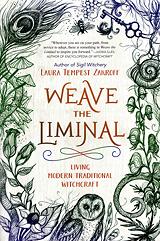
Weaving the Liminal
- by Laura Tempest Zakroff,
© 2019, ISBN 9780738756103. It's For understanding what Modern Traditional
Witchcraft is, and what it needs from you. Whether you are just starting out,
or well on you path, this is a "must read" book. Laura has other books for
specific aspects of Witchcraft: Altars, Sigils, Cauldrons, etc. Her Website
and Blog are:
https://lauratempestzakroff.com
https://lauratempestzakroff.com/blog
Disclaimer
Andrew Grygus
I do not call myself a Witch. I have a very good understanding of
witchcraft. I have studied Witchcraft and Paganism from many books by leading
Authors and by conversations with practitioners. I have collected plenty of
witchy tools, but don't currently feel Magic is my most urgent need.
My outlook on the world is as a largely (but not entirely) non-theist
Pagan, with great respect for the World, its beings, and for Science and
Quantum Mechanics. Paganism can in no way be described as an "organized
religion", so I can look at reality without adhering to doctrine.
Witches1 260607 - www.clovegarden.com/pagan/
- All images not otherwise credited are ©cc by 4.0.
Text ©Andrew Grygus - agryg@clovegarden.com