Magic in Our Time
This presentation wasn't easy - like trying to pack an elephant
into an 8 ounce can, so we will explore only magic as practiced today in
North America and the British Isles.
The largest contingent practicing Magic calls themselves Witches,
but when I use the word "Witch" here, it also includes Warlocks, Sorcerers,
Wizards, Magicians, Magi, Pagans, Druids, and other titles. Functionally,
their Magics are all too alike to treat separately.
Among all these groups, regardless of path, the basic theories and
methods are remarkably similar. Any practitioner can easily understand the
methods of any other practitioner. It's not like religion at all.
The 21st Century is "A Time of the Witches". They abound, from
Aesthetic Witches who just like the look, costumes, bling, and play-acting,
to very serious practitioners on a variety of paths. In the top ranks are
teachers and healers. Many Witches of all types are refugees from the
Evangelical churches, and other restrictive forms of Christianity.
Witchcraft and Magic today are composed of many past and recent
influences, so we'll first look at those. Over the centuries there have
been two parallel paths of Magic, Formal Ceremonial Magic, and Folk Magic.
Until the 20th century there was no significant crossover between
the two.
Traditional Folk Magic
is still with us, especially among the
Cunning Folks of the Appalachian region. We also have Hoodoo, from Africa.
That's Hoodoo not Voodoo. Voodoo is a religion.
The Witchcraft of the Witch Trials was entirely fiction, made
up during the trials. A major reference was a book detailing large witch
trials in Italy. That book has proven to be entirely fiction. Those
trials never happened.
Ceremonial Magic
began with Medieval Alchemy, drawing from
Arabian, Greek, Roman, Hebrew, and Christian mysticism. The objective was
transformation. The Great Work was transformation of the Alchemist himself
into a higher state of being. Of course, Alchemists needed to eat, so
promising transformation of lead into gold and an elixir of immortality
enabled them to get research grants.
From the Renaissance to the 20th century, Ceremonial Magic was
carried on by the Hermetic Orders. These Secret Societies promised a path,
through organized teachings and a hierarchy, to achieve a higher state of
being. Research grants weren't needed, as these orders belonged to the
upper classes. They also functioned as men's clubs where nobles and wealthy
merchants plotted taking over the world. Kings were uncomfortable with them,
and the Church declared them Demonic.
The last Hermetic Order was the Golden Dawn, established in 1887
to teach Hermetic Qabalah, astrology, occult tarot, geomancy, and alchemy,
all within a strict hierarchy. By this time hieroglyphics had been
translated, so a good dose of Egyptian religion, symbology, and costuming
was incorporated.
Alister Crowley, a controversial figure, left the Golden Dawn for
other adventures. In 1907 he and some others from the Golden Dawn established
their own Order. The Order's name is not pronounceable, but the system they
created is called "Thelema".
Thelema uses a lot from the Golden Dawn, and is very heavy on the
Egyptian, but is not a Secret Society. It was explained profusely
in Crowley's many books. Thelema is still active today. It was strongly
promoted by Jack Parsons and his wife. Jack was founder of JPL and Aerojet.
The core of Thelema is to find your True Will, and act upon it.
This is not the will of the ego, but the Will that is your purpose for
being in this world, the lessons you are here to learn. This has been
deliberately misconstrued by many, especially the Churches.
Animism
, humanities original world view, contributes strongly to
Witchcraft and Paganism today. It holds that every entity has consciousness
appropriate to its place and kind, animal, plant, or mineral. Large
consciousnesses like mountains and rivers are built from smaller
consciousnesses - like your body, composed of trillions of cells, each with
its own life, contributing to make you. This concept is now very seriously
considered by scientists studying consciousness, but they call it
"pansychism". Quantum Physics has proposed consciousness as a necessary
characteristic of matter. It's turtles all the way down.
Witches
are encouraged to treat their tools as living things,
and to go out in nature and talk to the trees, and frogs, and to assure
newts their eyes will not be used in a witch's brew.
Karl Jung
is another influence. His concept of Shadow Work is
important in some Witchcrafts - digging deeply into your own inner being,
facing aspects of yourself that are less than optimal, then working to
resolve them.
Wicca
was expected to be a revival of ancient Celtic
witchcraft. Turned out nothing was known about ancient Celtic witchcraft,
so it all had to be made up. Wicca instead became an ecstatic religion with
a large dose of Thelema and the Golden Dawn. The Wiccan "Wheel of the Year",
with 4 major and 4 minor seasonal festivals has, in various ways, been
adopted by many Witches, Pagans, Druids, and others.
Asian influences
Buddhism, Yoga, and Daoism are easy to see in
Witchcraft today. Especially used is the system of Chakras from India.
Science
Magic today dos not conflict with Science. Magic
is not of the physical world, and its influence on the physical is
severely constrained - sorry Harry Potter.
So, how then does Magic work at all? - First we look at theory,
then practice.
Quantum physics
has postulated that much of our universe is not
physical and cannot be seen felt or measured by physical science. They have
even done some very tricky experiments to confirm this is so.
Magic likewise holds that there is a realm of reality that cannot
be seen by physical means, a Liminal realm between the physical world
and the Other Worlds. Some Witches call it "the Hedge", and describe
themselves as "Hedge Witches.
Neither the Quantum nor Magical concepts are in some other place -
we are immersed in them and they permeate us. Whether distance is a
characteristic of this realm is currently unknown, but communication that
is distant to us seems to be instantaneous, like quantum entanglement is.
Science cannot define what consciousness is. I have a new book
(copyright 2025), that's a compendium of current scientific theories of
consciousness. It states, on the first page, that science can't define
consciousness, so the theories analyze how the complexity of the brain
supports consciousness. Some scientists are starting to consider
that perhaps it is consciousness that creates complexity.
Our Consciousness clearly operates in the physical world through
our bodies. We can see and feel that. Magic holds that, not being physical,
consciousness also has agency in the Liminal realm.
Does this Liminal realm exist? I have had at least 8 experiences
that strongly suggest it does, including 3 that bend coincidence far beyond
the breaking point. Many people have similar experiences, but most suppress
them or try to explain them away. Besides, how can you be "Spiritual" without
a place for Spirits?
Witches
are the largest contingent practicing magic. When people
think of Witches, they think of spells, covens, and fancy costumes. OK, the
fancy costumes we've got.
Covens were an invention of the Witch Trials. Witches of the past
were solitary practitioners, as most Witches are today, but Witches today
are not so isolated. They attend big conventions where they exchange ideas,
attend classes, and buy witchy things. Many have friends with similar
interests - and, there's also that Internet thing.
There are plenty of brilliant teachers and writers in the field
of Magic today. So, are these the people you go to to learn how to cast
spells?
Well, not right off. The top teachers emphasize working with the
inner self, organizing, developing power, problem solving, and learning
to work with the energy of the Liminal.
Some things the best teachers emphasize are:
- You must find the path that works for you. It will be different
from anyone else's path, but neither is wrong, just different.
- Responsibility - You are responsible for your actions, in this world
and in the Liminal, totally, no excuses.
- Respect - for yourself, other people, the Earth and its living
beings, and any beings you may encounter in the Liminal.
- Ethics - What is unethical in the physical world is unethical
with magic. You don't do magic on or for another person without their
concent - except hexes.
Exploring the Liminal is like a walk in the wilderness. Bright
flowers, mighty trees, birds, butterflies, and cute bunnies - and bears,
wolves, cougars, and snakes.
The first teaching is usually Grounding and Centering. Grounding
is reinforcing your energy flow into the earth. Centering is getting your
own internal energy in order so it's not scattered and vulnerable.
Next is Shielding and Warding. Shielding is creating a protective
wall against unwanted influences. Warding is making yourself look dangerous.
Both Shielding and Warding are commonly done for places as well as people.
Then meditation, trance, dreaming, and the relationship of
the body with the flow of Liminal energy. A few short spells are often
provided to help you with this internal work, and other tools are discussed.
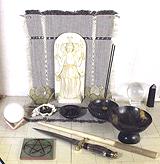
Symbols are the tools of magic. Even the basic physical tools,
the Wand, Sword, Cup, Pentacle, Candles, and Incense are really symbols for
complex concepts. Concepts, being immaterial, work on and with consciousness.
Words are powerful for explaining complex concepts, but cumbersome
for magical workings. Symbols can represent phrases, paragraphs, or even
chapters at a glance. For this there are systems of taking a concept
you wish to work with and distilling it into a symbolic image called a sigil.
A sigil may be just a simple pattern of lines, or it can be very
artistically drawn, depending on the practitioner. Essential is that it
conveys a concept with just a glance, by eye, or in your mind. It will
be meaningless to others unless explained.
But, what about Spells?
Once you're working with the basics and have set up your altar, you
should have a pretty good idea of how to make up spells and how they work.
While not strictly necessary, candles, potions, incense, and other tools can
really assist in keeping your attention focused.
Spells can be aimed at many things, improving your life situation,
relating with spirits and deities, and healing yourself or others, even at
a distance if necessary. They can also be used for hexing and cursing, but
take care, those practices can come back at you.
Some people equate spellcasting with prayer. They are actually
much different. With prayer you ask some entity to take charge of the
situation. If that entity doesn't agree, or is busy right now, you're up the
creek without a paddle.
When casting a spell, you are announcing that you are fully in
charge. That spell may, or may not, ask assistance from some entity, but if
that entity declines, you still have a firm grip on the paddle and your own
energy to apply.
You don't try to use magic to do things you can do physically -
but it can assist that work, increasing the odds. Spells affect yourself,
and can affect others through the Liminal. People with no concept of magic
still have consciousness that touches the Liminal, and can be influenced
through it. That's how Magick gets things done in the physical world.
When composing spells you must think very hard about what could
go wrong. The goal must be very specific, but how that goal is achieved
must be fairly loose. It is said that magic always seeks the path of least
resistance.
Then there's that old cliché of summoning Demons to do you
bidding. That's not much done today. Demons don't like that, and it'll
likely not end well for you.
Divination
, and symbology, and timings of Astrology are also
very important in many magical practices, but used differently than in the
past. Those are complex subjects that will have to be explored at some other
time.
Thank you. I can take questions, now or during the social time.
Disclaimer
- Not part of the presentation.
Decades ago, I studied the ceremonial magic of the Golden Dawn and
Thelema, but, unlike Jack Parsons. I never actually participated in it.
I've recently spent considerable time studying magic as it is practiced
today. I have the tools, the knowledge, and have done basic orientation,
but I haven't been much into casting spells, because I haven't had the
need.
 I am a largely Non-theist Pagan, but have invited several Goddesses into my
household: Hekate, Aset, Nebet-het, and Freya, who has branched out from her
Scandinavian roots - note her very India style pose and Japanese
companion (Shinto I presume). It's all good - Vedic Hinduism originated
from the same Proto Indo-European root as Scandinavian Paganism.
I am a largely Non-theist Pagan, but have invited several Goddesses into my
household: Hekate, Aset, Nebet-het, and Freya, who has branched out from her
Scandinavian roots - note her very India style pose and Japanese
companion (Shinto I presume). It's all good - Vedic Hinduism originated
from the same Proto Indo-European root as Scandinavian Paganism.
Andrew Grygus
Magick01p 250713
- www.clovegarden.com/pagan/
©Andrew Grygus - agryg@clovegarden.com